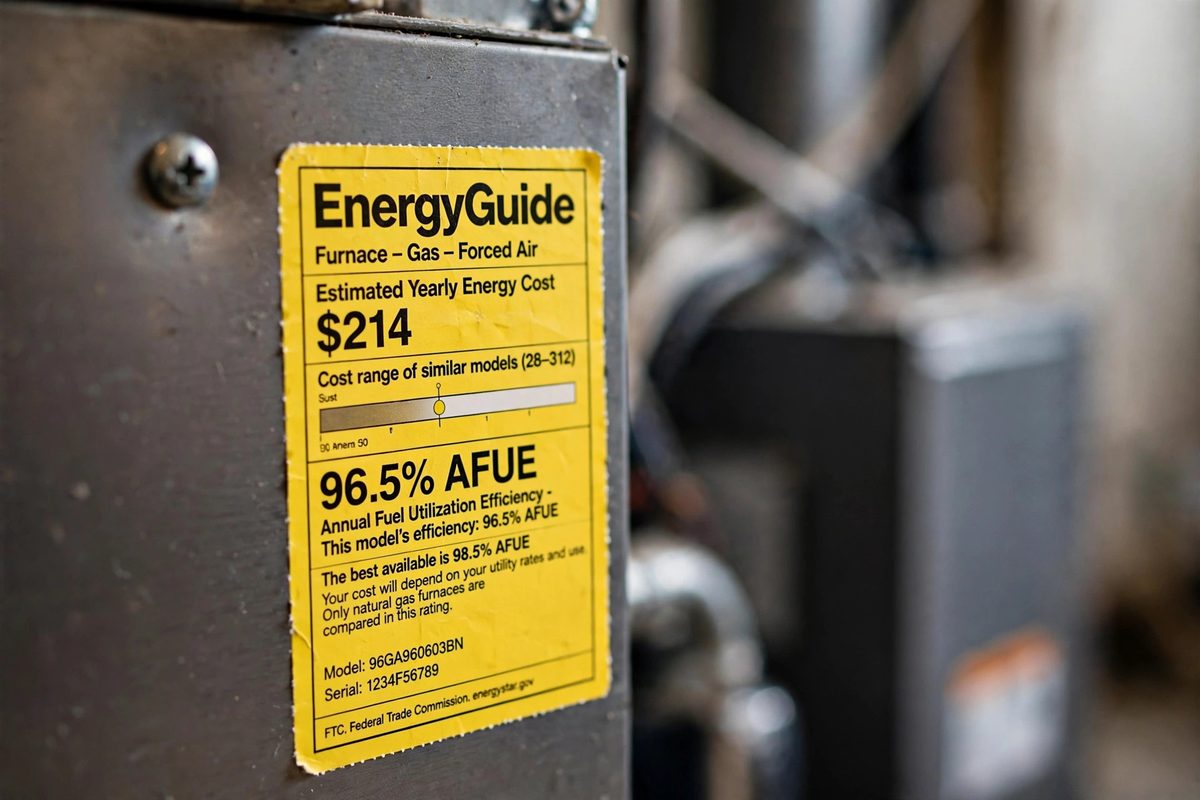
AFUE stands for Annual Fuel Utilization Efficiency. It answers one question: of all the fuel your furnace burns in a year, what percentage becomes heat for your house? An 80% AFUE furnace turns 80 cents of every fuel dollar into warmth and loses 20 cents up the flue. A 95% AFUE furnace loses only 5 cents. That is the entire concept.
It is a useful number, but it is not the whole story of heating efficiency. Here is what AFUE tells you, what it does not, and how to use it.
What 80 and 95 really mean
Furnaces cluster into two camps. Standard-efficiency units sit around 80% AFUE: proven, simpler, and less expensive to install, with a fifth of their fuel going up the vent. High-efficiency condensing furnaces run 90% AFUE and above, squeezing so much heat from the exhaust that it condenses into water, which drains away through a condensate line. The higher the number, the less fuel wasted, but also the more complex the unit and the installation.
Finding the rating on your furnace
Check the yellow EnergyGuide label on the furnace cabinet first; AFUE is printed there. It is also in the model specifications, which you can look up from the model number on the nameplate. If the label is long gone and the unit is old enough, assume the low end: furnaces from decades past often ran well below today's minimums, which is part of why replacing them changes the bills so noticeably.
What AFUE does not tell you
AFUE measures the furnace in a lab, not the furnace in your house. It says nothing about your ductwork, and a 95% furnace connected to leaky ducts still heats the attic. It does not account for sizing: an oversized high-AFUE unit short-cycles its efficiency away. It also ignores the electricity the blower and controls use. Real-world efficiency is AFUE times installation quality times duct condition times maintenance. The rating is one factor of four.
We can find the rating, assess the real-world efficiency, and tell you what an upgrade would change.
Using AFUE when you shop
When comparing new furnaces, use AFUE as a starting filter, then ask about the rest: proper sizing from a load calculation, two-stage or variable-speed operation for comfort, and the condition of your ducts. A mid-90s AFUE unit, correctly sized and installed on sealed ducts, beats a higher-rated unit installed carelessly. That is why a high-efficiency furnace installation is as much about the workmanship as the equipment. And whatever you buy, furnace maintenance protects the efficiency the unit was built to deliver, because a dirty high-efficiency furnace performs like a neglected standard one.
Frequently asked questions
Is a 95% AFUE furnace always better than an 80% one?
It wastes less fuel, but better depends on the house. High-efficiency units need condensate drainage and different venting, and they reward good ductwork. In some homes the installation differences matter more than the rating gap. Compare the whole picture, not just the number.
Where do I find my furnace's AFUE rating?
On the yellow EnergyGuide label on the cabinet, or in the specs for your model number. The model number is on the nameplate inside the furnace. A technician can also identify it during a service visit.
Does AFUE apply to electric furnaces?
Not meaningfully. Electric furnaces convert nearly all their electricity to heat by nature, so the rating system was built for fuel-burning equipment. Comparing a gas furnace's AFUE against an electric unit's efficiency is comparing different things.
Will a higher AFUE fix high heating bills by itself?
Only partly. Bills also depend on duct leakage, insulation, thermostat habits, and whether the unit is sized right. A high-AFUE furnace on bad ducts is like a sports car on flat tires: the potential is there, but the delivery is not.
What is the minimum AFUE for new furnaces?
Federal minimum efficiency standards apply to new gas furnaces, and the minimum has risen over the decades. Your installer works to the current standard automatically. The practical question is how far above the minimum makes sense for your home and climate.
Sources and Further Reading
Last updated: October 19, 2026
Shopping by AFUE and want a straight explanation?
We will compare ratings honestly and size the right system for your house, not just the highest number.