Replace a furnace that had years left, and you spent money you did not need to. The decision feels like a gamble, but it does not have to be.
Run through them in order, and be honest about the unit's history. The pattern matters more than any single breakdown.
Start with the repair-half rule of thumb
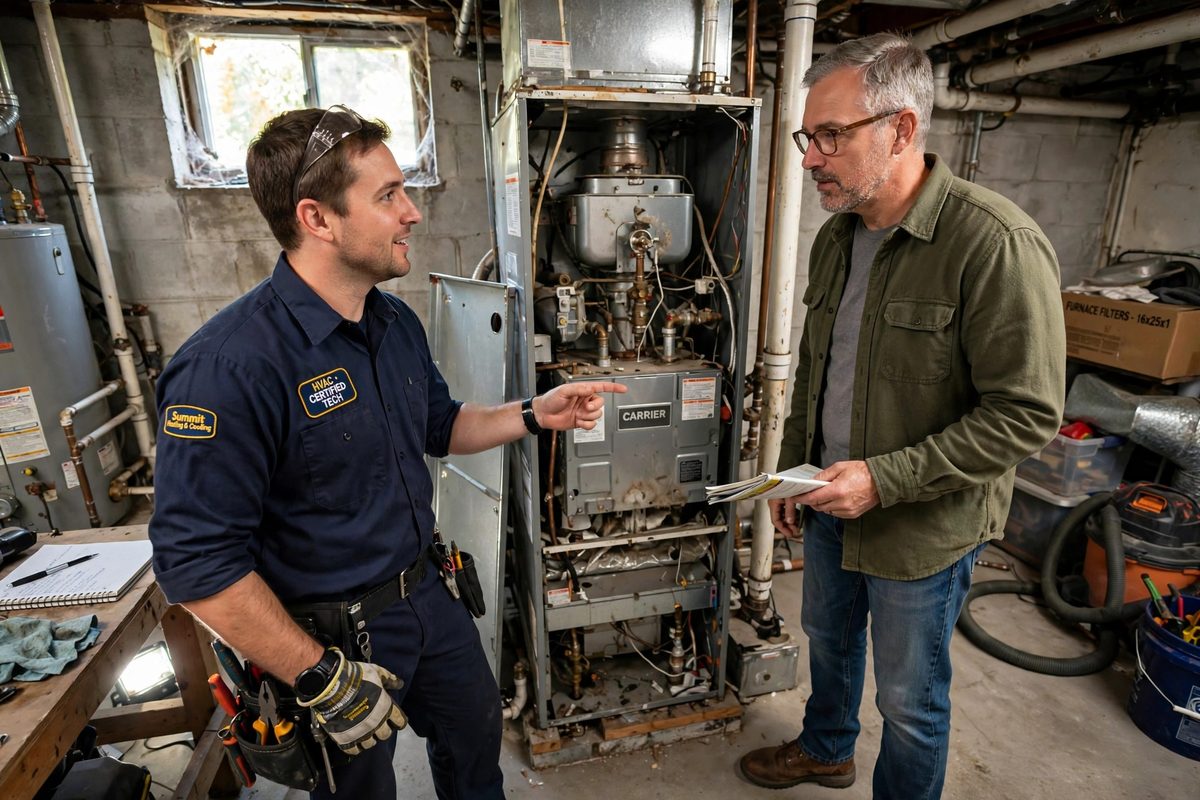
Compare the repair estimate against the value of a new system. When a single repair approaches half the worth of a replacement, replacement usually wins, because you are investing heavily in a unit with the same old parts everywhere else. A minor repair on an otherwise healthy furnace, on the other hand, is almost always the right call. The rule is a guideline, not a law, but it keeps emotions out of the math.
Age changes the math
A ten-year-old furnace with a failed igniter deserves a repair; it likely has half its life left. The same repair on an eighteen-year-old unit with a history of breakdowns is money spent on borrowed time. Past roughly fifteen years, every major repair should trigger the replacement question, because the remaining parts are all the same age as the one that just failed.
Consider what a repair cannot give you
Replacement is not only about avoiding the next breakdown. Newer furnaces offer steadier temperatures through two-stage or variable-speed operation, quieter running, and better humidity control when paired with the right accessories. If your old single-stage unit leaves rooms uneven and noisy, no repair delivers the comfort a new system does. That comfort gap is a legitimate part of the decision, not just a sales pitch.
When repair is clearly the smart call
Repair when the furnace is under about twelve years old, the problem is a single failed part like an igniter, flame sensor, or capacitor, the unit has been maintained, and this is the first real trouble it has given you. Those repairs are straightforward, and the furnace should run reliably for years afterward. Our furnace repair in Herndon service handles exactly these cases every day.
Get a straight assessment of the unit's overall condition before you authorize the work.
When replacement wins
Replace when the heat exchanger is cracked, when repairs have become an annual ritual, when the unit is past fifteen and needs a major part, or when heating bills and comfort have been sliding for years. Also replace when the furnace was never the right size for the house: no repair fixes a sizing mistake. A proper furnace replacement starts with a load calculation so the new unit actually fits.
Frequently asked questions
Is there a simple rule for repair versus replace?
The common guideline: if the repair approaches half the value of a new system, or the furnace is past 15 with a history of breakdowns, lean replacement. If the unit is younger, maintained, and this is an isolated failure, lean repair.
My furnace broke down twice this winter. Should I replace it?
Two breakdowns in one season on an older unit is a strong replacement signal, because the failures tend to keep coming. On a younger maintained unit, two failures may share one root cause worth diagnosing before deciding.
Does a new furnace really use less fuel?
Usually, yes, especially when replacing a worn older unit. How much depends on the efficiency jump, the sizing accuracy, and the condition of your ductwork. A new high-efficiency unit on leaky ducts still wastes heat, so ducts matter too.
Can I replace just part of the system, like the heat exchanger?
On a younger furnace, sometimes. But heat exchanger replacement is major surgery, and on a unit past its mid-teens the remaining parts are equally aged. Most technicians recommend weighing full replacement once the exchanger fails on an older system.
How do I know a replacement recommendation is honest?
Ask to see the evidence: the cracked part, the failed component, the repair history. A trustworthy technician explains why repair is a bad bet for your specific unit rather than pushing replacement as the only option. Get a second opinion if anything feels rushed.
Sources and Further Reading
Last updated: October 19, 2026
Repair or replace? Get an answer you can trust.
We will show you what failed, what else is wearing out, and which option actually makes sense for your home.